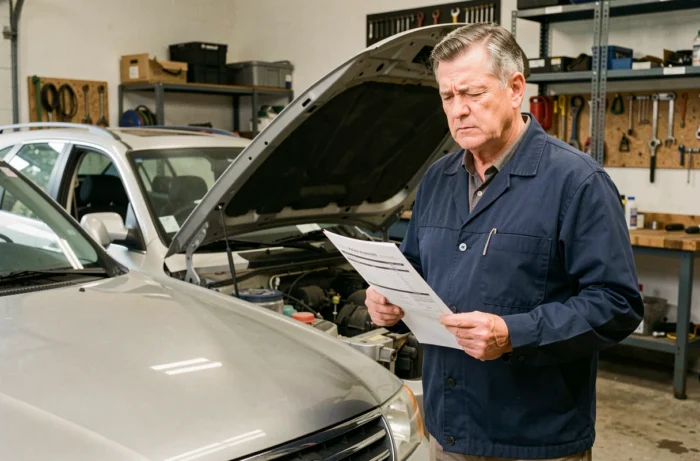
When the mechanic presents a repair estimate that exceeds the value of the car, one finds oneself stuck between two unappealing options: pay more than the vehicle’s worth or part with it. This situation is common with cars over ten years old, where a simple side impact or engine failure is enough to tip the scales.
Understanding the mechanisms at play, particularly the VEI procedure and the concept of VRADE, allows one to regain control over the decision.
VRADE and Argus value: the difference that changes compensation
It is often thought that the insurer bases the vehicle’s value on the Argus value. In practice, the reference used is the VRADE, the replacement value as determined by an expert. This corresponds to the price that would need to be paid to buy a comparable vehicle at the time of the incident, taking into account the actual mileage, options, general condition, and depreciation.
The Argus value provides a market trend, but it does not reflect the specifics of a particular vehicle. A well-maintained diesel with low mileage can be worth significantly more than its catalog value. When wondering what to do when car repairs are too expensive, the first reflex should be to check on what basis the expert calculated this VRADE.
One can demand the references used by the expert: ads for comparable vehicles, depreciation grids, adjustments related to equipment. If the estimate seems low, gathering ads for equivalent models on second-hand sales sites can be a concrete lever to contest the proposed amount.

VEI procedure: what happens when the estimate exceeds the vehicle’s value
When the expert report concludes that the repairs cost more than the VRADE, the vehicle is classified as VEI, economically irreparable vehicle. This classification triggers a procedure governed by the highway code.
The insurer must then formalize a compensation offer within fifteen days of delivering the report. This offer corresponds to the VRADE, in exchange for the transfer of the vehicle. The owner has thirty days to accept or refuse.
Accepting the transfer
You receive the compensation, you transfer the vehicle. This is the simplest scenario, but it assumes that the proposed amount actually allows for the purchase of an equivalent vehicle. If the second-hand market is tight for the model in question, the compensation may prove insufficient.
Refusing the transfer and keeping the vehicle
This is the lesser-known option. One can refuse to transfer the vehicle, but the refusal leads to an opposition to the transfer of the registration certificate. In practical terms, you can no longer sell the vehicle to a private individual until the procedure is lifted.
To lift this opposition, one must:
- Have the repairs done, particularly those affecting safety components (brakes, steering, lighting, structure)
- Pass a new technical inspection once the work is completed
- Obtain a second expert report confirming that the vehicle can operate normally
The difference between the cost of repairs and the compensation paid remains entirely the owner’s responsibility. For an older car that one is attached to, this option can make sense, provided that the remaining costs have been accurately calculated.
VEI and VGE: two classifications, two realities
The confusion between VEI and VGE often arises. The VEI is based on a purely economic calculation: the repairs cost more than the vehicle. The VGE (severely damaged vehicle) concerns a structural safety issue that can lead to an immediate prohibition on circulation.
A vehicle classified as VGE requires a second expert report after repairs to be allowed back on the road. The constraints are heavier, and the timelines vary based on the experts and prefectures.
In the case of a simple VEI, the owner’s margin for maneuver is broader. The vehicle is not dangerous; it is simply considered too costly to repair compared to its market value.

Reducing repair costs: reused parts and comparative estimates
When one decides to keep the vehicle despite the VEI classification, the goal is to reduce the actual amount of work. Reused parts (from end-of-life vehicles) represent a serious option, particularly for bodywork: hoods, fenders, bumpers, lights.
An estimate with reused parts can significantly lower the bill compared to an estimate with new original parts. Not all garages spontaneously offer this option; it must be explicitly requested.
Some points to check before committing:
- Request at least two estimates from different garages, specifying that you accept used parts
- Ensure that safety parts (brake discs, shock absorbers, airbags) remain new or certified refurbished parts
- Make sure the mechanic documents the repairs for the second expert report
- Compare the final remaining costs with the price of an equivalent vehicle on the second-hand market
This last point is the real arbitration. If the remaining costs after compensation exceed the price of a comparable vehicle in good condition, keeping the car is more about attachment than rational calculation.
The rising costs of car repairs are pushing more and more vehicles towards VEI classification, including models that still run perfectly. Knowing the VRADE, demanding the expert’s justifications, and comparing estimates remains the best way not to be subjected to the insurer’s decision. Whether to keep or transfer, both options are defensible, but neither should be taken without having checked the numbers oneself.