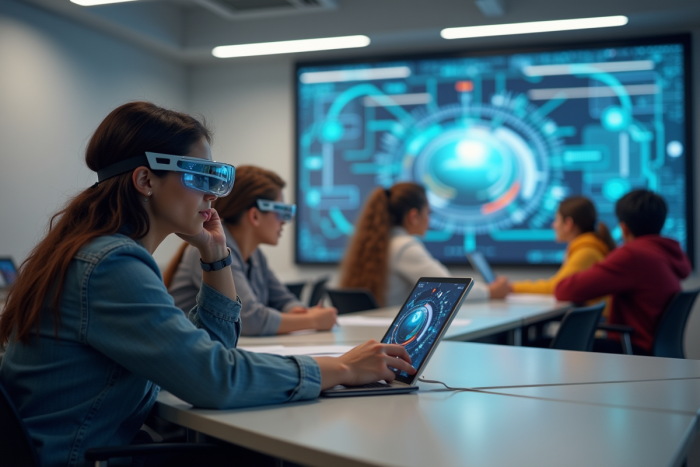
In 2025, classrooms are unrecognizable compared to those from ten years ago. Blackboards have been replaced by interactive screens, and textbooks have been substituted with tablets. Teachers use online platforms to share resources, track student progress, and offer personalized courses.
Digital tools have also opened the door to new learning methods. Students can participate in virtual classes with teachers from around the world, explore augmented reality environments, and access infinite digital libraries. Education is thus becoming more accessible, interactive, and tailored to individual needs.
Essential Digital Tools for Education in 2025
Schools, engaged in a process of modernization and digitalization, rely on several resources and platforms to meet the needs of teachers and students. Among these tools, Digital Work Spaces (ENT) stand out for their ability to provide unified access to various services and resources.
- Oze: This portal, whose usefulness is highlighted in the article ‘OZE ENC 92 connection: practical guide for students and teachers – Jobassistant.fr’, facilitates administrative and educational management within schools.
- Éduthèque: This portal provides access to over 80,000 educational resources, enriching teaching and allowing teachers to adapt their courses.
- Educational Digital Resource Banks (BRNE): Offering educational content and assessment tools, these banks cater to students from CM1 to terminale.
Schools also use ETINCEL to support technical and industrial education, and Édu-Up to promote learning in programming and artificial intelligence. These resources address the growing need for digital skills in the educational world.
Teachers can train on the M@gistère platform, which offers over 350 training courses, and validate their skills with the Computer and Internet Certificate Level 2 (C2i2e). The upskilling of teachers is essential to ensure quality digital education.
Digital tools, such as Digital Work Spaces and various online educational resources, are transforming education by making it more accessible, interactive, and tailored to the needs of students and teachers.
The Challenges and Opportunities of Integrating Digital Technology in Education
The transition to digital education raises many challenges. Anne Alombert, a philosopher, deconstructs the terms ‘artificial intelligence’ and ‘machine learning’ to reveal their philosophical implications. Giuseppe Longo explains that machine memory is merely a revisable digital storage, raising questions about the reliability and durability of these technologies.
David Bates and Bernard Stiegler analyze the risks of cognitive degeneration associated with the intensive use of AI. Their research highlights potential dangers for students’ intellectual development, emphasizing the need for rigorous oversight. Jean-Gabriel Ganascia complements this perspective by presenting a discussion on the history and ethical issues of artificial intelligence.
However, the integration of digital technology in education also offers significant opportunities. Hervé Le Crosnier explains the sources of the digital utopia from the early days of the Internet and the Web, recalling the ideals of sharing and collaboration that initially motivated these innovations. Stewart Brand, creator of the Whole Earth Catalog, and Douglas Engelbart, director of The Mother of All Demos, are iconic figures of this utopian vision.
The CNIL, which coordinates the Educnum Collective, plays a key role in protecting personal data and promoting digital citizenship. The Institute for Studies and Research on Law and Justice (IERDJ) studies the applications of text automation in judicial matters, highlighting the legal and ethical issues of these technologies. Richard Stallman, initiator of the free software movement, emphasizes the importance of ensuring equitable access to digital resources.