
The autumn-winter and spring-summer collections now respond to each other on common ground: lingerie dictates the codes of visible fashion, and women’s fashion borrows from lingerie its materials, cuts, and finishes. This crossover is no longer just a runway effect. It structures purchases, ranges, and production constraints.
Single-material and recyclability: the true technical filter of lingerie collections
The most structuring trend this season is not visible on a rack. It is reflected in the composition of the pieces. Chantelle announces that, for its spring-summer 2026 collections, 79% of the references are single-material and 94% contain a maximum of 5% elastane. The goal is to simplify sorting and recycling at the end of life.
This approach modifies the very design of bras and panties. The use of ultra-lightweight non-metallic underwires, announced for production in 2026, allows for the elimination of a classic bottleneck in the recycling chain. A steel underwired bra mixed with polyamide and elastane is, in practice, impossible to recycle industrially.
For those who select their pieces with a minimum of requirements, checking the elastane content and the number of materials on the back of the label becomes as relevant a reflex as checking the size. We observe that the fashion new arrivals on Lingerie & Séduction reflect this evolution towards more readable compositions.

Environmental labeling and repair funds: what the law changes for women’s fashion
Displaying environmental impact is becoming a concrete purchasing criterion, beyond marketing. French law now directly targets the ultra-fast fashion model, with specific penalties under the extended producer responsibility (EPR) for textiles.
Repair becomes a lever for commercial differentiation. The regulatory calculation includes the existence of a repair service and the ratio between the repair cost and the product price. From July 1, 2024, information about the repair fund must be visible in physical and online sales points.
For lingerie and women’s ready-to-wear brands, this means that offering a tailoring workshop or a partnership with a network of approved repairers is no longer just a communication gesture. It is a parameter that directly influences the penalty or bonus applied to each reference launched on the French market.
Second-hand: not all channels are equal
Treating second-hand as a homogeneous block is an analytical error. A study shared by CMCM compares the impact of re-circulating clothing based on the channel: solidarity shop, commercial thrift store, or online platform. The discrepancies relate to transport, reconditioning, and the rate of pieces actually reported.
For lingerie, second-hand remains marginal in volume, but pieces of women’s fashion (dresses, jackets, skirts) circulate massively on platforms. We recommend considering the resale channel as a standalone criterion when discussing responsible fashion.
Visible lace and lingerie cuts: how the trend structures autumn silhouettes
The transfer of lingerie codes to everyday wardrobes hinges on three specific technical elements:
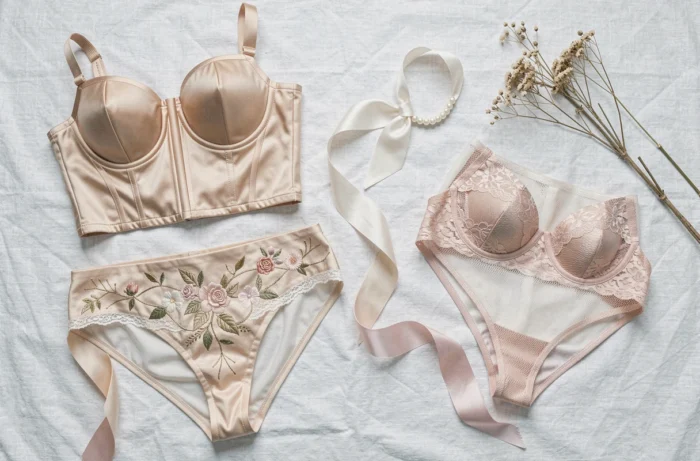
- Lace as the main material, rather than just a simple trim. Tops, dresses, and skirts incorporate panels of structural lace that contribute to the support of the piece, not just its aesthetics.
- Cutouts borrowed from bras (V seams, bust darts, underbust bands) appear on blouses and dresses worn daily. They reshape the silhouette without resorting to separate shapewear.
- Visible straps, whether thin or wide, become an accepted detail. Adjustability and the quality of the finish (flat stitching, covered elastic) distinguish a well-designed piece from a superficial effect.
This movement is not a mere aesthetic citation. It changes expectations regarding comfort and support in garments that do not strictly fall under the lingerie category.
Separate pieces and kit fashion: the women’s wardrobe is decomposing
Designers have massively adopted the logic of separate pieces this season. We move away from the idea of a total look towards a wardrobe built over time, where each piece adds a soul to the rest of the wardrobe.
In practice, this favors women who invest in a few quality pieces rather than complete outfits. A lingerie-cut top can be worn with tailored trousers or a midi skirt. A dress with thin straps can be layered over a soft knit to play with texture contrasts.
The skirt, a key piece of the season
The skirt has made a strong appearance on the runways with a variety of lengths and volumes. It works particularly well in this mix-and-match logic, as it accommodates both structured tops and fluid lingerie-inspired tops.
Palettes revolve around pastels and powdery tones, which visually extend the lingerie range into the visible wardrobe. Details (bows, trims, fine passementerie) recall the finishes typically found on high-end lingerie pieces.
Colors and materials: the convergence of lingerie and ready-to-wear
Skin tones, powder pink, midnight blue, and ivory dominate both lingerie collections and women’s ready-to-wear lines. This convergence is not trivial: it allows for layering (visible bralette under an open shirt, camisole under a blazer) without chromatic disruption.
On the materials side, wash satin and recycled microfiber are gaining ground against classic polyester. The hand of the fabric (its touch, its fluidity) becomes a selling point as much as the visual aspect. Informed buyers touch before they look, and online product sheets are starting to detail weight and composition with more precision.
- Wash satin: matte touch, fluid drape, suitable for lingerie cuts worn outdoors.
- Recycled microfiber: lightweight and breathable comparable to virgin fibers, with a more favorable environmental display.
- Mechanical lace with continuous thread: more resistant to washing than lace with cut threads, and better suited for everyday use.
The season confirms that the boundary between lingerie and women’s fashion is not closing. Regulatory constraints, material choices, and aesthetic codes converge towards a wardrobe where each piece, visible or not, meets the same requirements for composition, durability, and style.