
Tabbouleh does not freeze well. Semolina that becomes mushy, raw vegetables that release their water, herbs that turn black: the list of potential damage is long. Freezing tabbouleh is technically feasible, but the result depends less on the freezing method than on what you put in before closing the lid.
Semolina or bulgur: the behavior in the freezer is not the same
Articles on freezing tabbouleh treat semolina as a homogeneous block. The reality is more nuanced. Fine wheat semolina, the type found in most French tabbouleh, absorbs a lot of water during preparation. In the freezer, this water forms ice crystals that rupture the grain structure.
Bulgur, the base of traditional Lebanese tabbouleh, behaves differently. Its firmer texture and thicker grain resist ice crystal formation better. After thawing, a bulgur-based tabbouleh retains its structure more than a fine semolina-based tabbouleh.
To understand how to freeze homemade industrial tabbouleh without ruining it, this distinction between the two cereal bases is the first criterion to consider. A frozen and then thawed fine semolina tabbouleh will almost systematically have a sticky consistency, regardless of the care taken in the process.
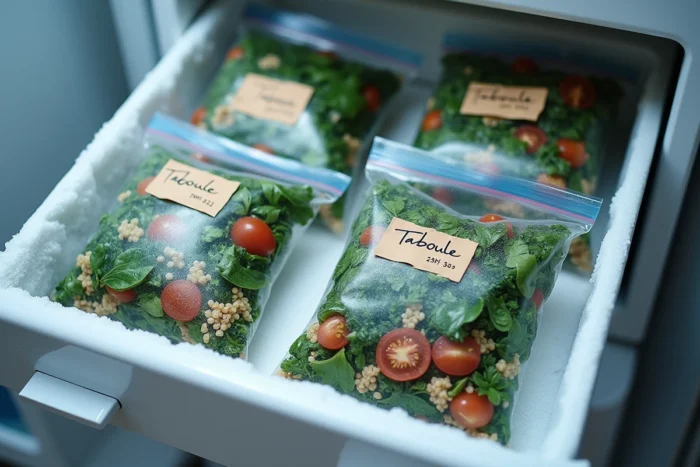
Industrial tabbouleh and freezing: the role of stabilizers
Tabbouleh sold in supermarkets contains additives that alter their behavior in the cold. Emulsifiers, preservatives, acidifiers: these ingredients are not there by chance. They stabilize the bond between oil, lemon juice, and cereals.
Olive oil separates from the rest after thawing in homemade tabbouleh. This phenomenon creates a greasy layer on the surface and an unbalanced texture underneath. The stabilizers in industrial versions limit this separation, which explains why the result is less disappointing with supermarket tabbouleh than with a homemade preparation.
This does not mean that industrial tabbouleh comes out unscathed from the freezer. Vegetables (tomatoes, peppers, cucumber) suffer the same cellular damage regardless of the recipe. However, the cereal base holds up better thanks to the formulation calibrated to withstand temperature variations during transport and storage.
Freezing homemade tabbouleh: what to remove beforehand
The most effective strategy is to not freeze tabbouleh as is. Some ingredients withstand freezing, others do not. Separating the components before freezing radically changes the final result.
Ingredients not to freeze with the rest
- Fresh cut tomatoes release their juice upon thawing and turn the tabbouleh into soup. Removing them before freezing and adding them fresh when serving preserves the overall texture.
- Cucumber follows the same pattern: its water content makes it unsuitable for freezing. It completely softens and loses all crunch.
- Fresh mint and parsley turn black and become bitter after a stint in the freezer. Adding them at the last moment is the only viable option.
What remains after this sorting (seasoned cereal, lemon juice, oil) constitutes a base that tolerates a few weeks of freezing without catastrophe. Freezing the cereal base alone and assembling the tabbouleh after thawing yields a significantly better result than freezing the complete dish.
The question of seasoning
The cold dulls flavors. A properly seasoned tabbouleh before freezing will taste bland after thawing. Slightly increasing the lemon and spices before freezing partially compensates for this loss, but the taste of fresh tabbouleh remains unattainable after freezing.
Thawing tabbouleh: the method that limits damage
Thawing in the microwave or at room temperature accelerates degradation. The water released by the ice crystals does not have time to be reabsorbed by the cereals, resulting in a liquid bottom under a compact mass.
Slow thawing in the refrigerator remains the only recommendable method. It requires patience: count on half a day for an individual portion. During this time, the semolina or bulgur gradually reabsorbs moisture, which limits (without eliminating) the mushy texture.
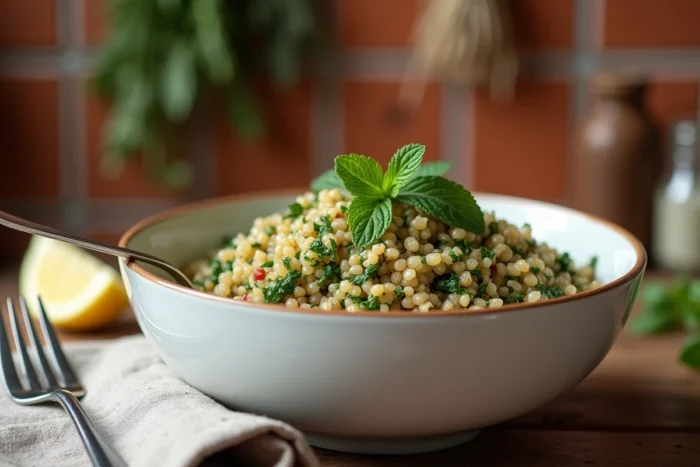
After thawing, a quick fluff with a fork to aerate the grains significantly improves the result. This is also the time to add the fresh ingredients removed before freezing: herbs, tomatoes, cucumber. This “reconstituted” tabbouleh will not compete with a freshly made preparation, but it will be edible and prevent waste.
Refrigeration: the often-sufficient alternative
Before pulling out the freezer bags, one question deserves to be asked: does tabbouleh really need to be frozen? Tabbouleh keeps well in the refrigerator for two to three days in an airtight container.
For weekly batch cooking, this duration more than covers the need. The semolina continues to absorb the seasoning over the hours, which sometimes makes the tabbouleh the next day tastier than that of the same day.
- Storing tabbouleh in an airtight glass container rather than plastic limits odor transfer in the fridge.
- Adding a drizzle of lemon juice before closing the container slows down the oxidation of the herbs.
- Keeping the tomatoes separate if the tabbouleh needs to last more than two days prevents their juice from soaking the semolina.
Freezing tabbouleh is justified in only one scenario: quantities too large to be consumed in the following days. In all other cases, the refrigerator offers a better compromise between practicality and taste quality. Tabbouleh is a dish of freshness, and it is precisely this freshness that the freezer takes away.