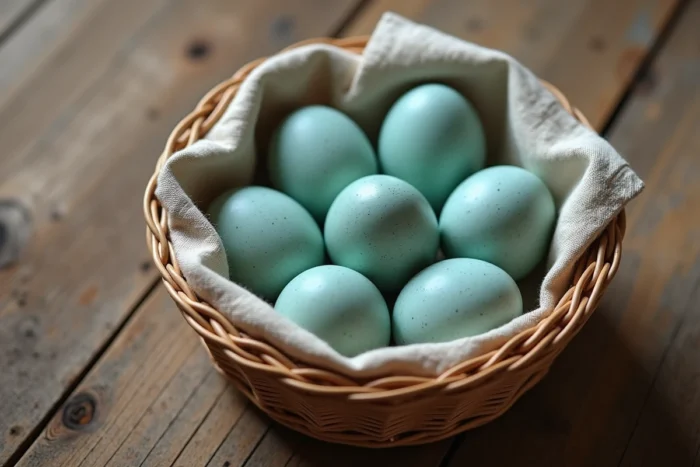
Blue eggs first surprise with their shell. You spot them at a market stall or in a farmer’s basket in a short supply chain, and the question immediately arises: does this color change anything about what we eat?
Laid by breeds like the Araucana or the Cream Legbar, blue eggs owe their hue to a natural pigment deposited in the shell during the formation of the egg. Their popularity has been growing in France for a few years, driven by the appeal of rare poultry products and short supply chains.
Biliverdine and blue shell: what happens in the hen’s oviduct
The blue color is neither a dye nor a coincidence. It comes from biliverdine, a natural pigment resulting from the breakdown of hemoglobin. In hens carrying the relevant gene, this pigment integrates into the very structure of the shell during its formation in the oviduct.
Specifically, if you crack a blue egg, the hue penetrates the entire thickness of the shell. A brown egg, on the other hand, is only colored on the surface. This difference also allows for the identification of a fake blue egg that may have been artificially dyed.
Since January 2026, French regulations require blue eggs to be labeled with information about their genetic origin and the absence of artificial dyes, according to the Journal Officiel de la République Française. This obligation protects consumers from confusion with dyed products. To delve deeper into the subject, you can consult the benefits of blue eggs on Kalinoe, which details these regulatory and nutritional aspects.

Blue eggs and allergies in children: does biliverdine pose a risk?
You may have heard parents express concern: could the blue shell trigger reactions in a sensitive child? The question deserves to be asked clearly.
Biliverdine is a pigment that our own body naturally produces during the recycling of red blood cells. It is what gives a greenish color to bruises as they heal. This pigment does not pass into the white or yolk of the egg. It remains integrated into the calcareous matrix of the shell.
Egg allergies, common in young children, are caused by proteins present in the white (ovomucoid, ovalbumin) or the yolk. These proteins are identical in a blue, brown, or white egg. The color of the shell does not alter the allergenic profile of the contents.
A child allergic to conventional eggs will also be allergic to blue eggs, and vice versa. No data links shell biliverdine to a specific allergic risk. Direct contact with the shell during handling is harmless for the vast majority of people, as biliverdine is not a recognized allergen.
Lutein and omega-3: the nutritional profile of Araucana blue eggs
Nutritionally, a blue egg contains the same major families of nutrients as a conventional egg: complete proteins, vitamins A, D, E, minerals, and fatty acids. The composition of the yolk directly reflects the hen’s diet.
A comparative analysis by INRAE dated February 2026 highlighted a notable point: Araucana blue eggs have a lutein content that is 20% higher than standard eggs. Lutein is an antioxidant in the carotenoid group, involved in protecting the retina. For those exposed to screens for long periods, it is a nutrient to monitor in daily nutrition.
The omega-3 content mainly depends on what the hen eats. An Araucana fed with flaxseed will produce an egg richer in omega-3 fatty acids than a hen fed only corn, regardless of the color of its shell.
- The lutein in the yolk protects the macula of the eye and filters some blue light, making it a sought-after nutrient for eye health.
- Choline, present in all eggs, contributes to proper liver function and nerve transmission. One egg covers a significant portion of daily needs.
- The proteins in eggs offer the best biological value among animal proteins, with nearly complete digestibility after cooking.

Choosing and checking your blue eggs: practical tips in short supply chains
The enthusiasm for blue eggs has created a market where quality varies greatly. Here’s how to tell the difference at a market or with a producer.
Lightly scratch the shell with your nail. A real blue egg remains colored throughout, as biliverdine permeates the entire calcareous structure. A dyed egg will lose its color on the surface.
Check the labeling. Since 2026, the mention of genetic origin must appear on the packaging. This requirement also applies to short supply chain sales at markets.
- Prefer farmers who identify the breed of their hens (Araucana, Ameraucana, Cream Legbar) on their signage.
- Ask about the hens’ diet: an intake of flaxseed, fresh grass, or insects improves the lipid profile of the yolk.
- Observe the color of the yolk when cracked: a deep orange yolk generally indicates a varied diet rich in carotenoids.
Feedback from organic poultry farmers in Brittany, reported by the Chambre d’Agriculture de Bretagne in April 2026, also indicates better resistance of blue egg-laying hens to common viral infections. This observation, noted in pilot farms, suggests that these hardy breeds are well-suited for free-range farming with fewer health interventions.
The blue egg alone will not transform your diet. Its advantage lies in a slight boost in lutein, enhanced traceability due to the new regulations, and the pleasure of consuming a product from breeds with preserved genetics. For the rest, it is what the hen eats that determines the quality of the yolk, not the color of the shell.