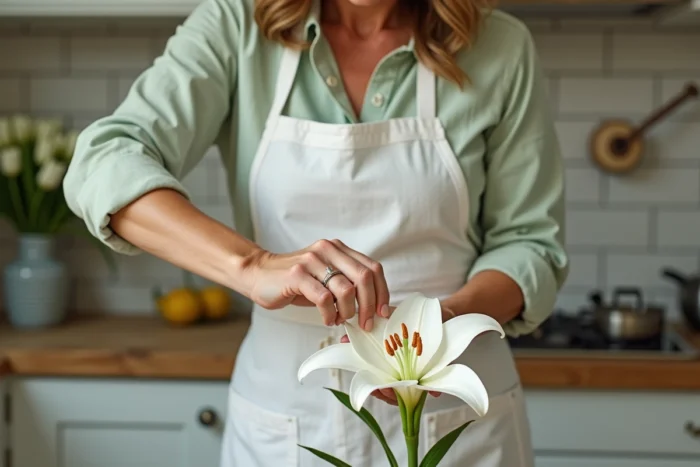
Lily pollen stains fabrics, tablecloths, and fingers within seconds of contact. Removing the lily’s pistil before arranging a bouquet or centerpiece reduces this risk to zero and prolongs the flowers’ lifespan. The question arises: when to intervene, with what action, and which varieties require the most vigilance?
Lily Pollen and Stains: Comparison of Damage by Surface
Lily pollen behaves differently depending on the material it touches. Before discussing removal techniques, this table summarizes the concrete risks for the most common surfaces in interior and event decoration.
| Surface | Stain Risk | Possible Removal | Main Precaution |
|---|---|---|---|
| Wedding Dress (satin, tulle) | Very High | Difficult, often irreversible | Remove the stamens before the ceremony |
| White Linen Tablecloth | High | Partial with quick treatment | Do not rub, expose to sunlight |
| Varnished Wood (table, console) | Moderate | Good if cleaned quickly | Wipe dry, no water |
| Natural Stone (marble) | Moderate to High | Variable depending on porosity | Vacuum the pollen, do not spread |
| Skin and Fingers | Low to Moderate | Easy with soap | Avoid touching the eyes |
The satin and tulle of wedding dresses concentrate the maximum risk. Florists specializing in weddings report an increase in requests for pistil-free lilies in suspended arrangements, specifically to avoid pollen falling on outfits.
To learn how to remove the lily pistil without damaging the flower, the timing of the intervention is as important as the action itself.
The Right Time to Remove Lily Stamens
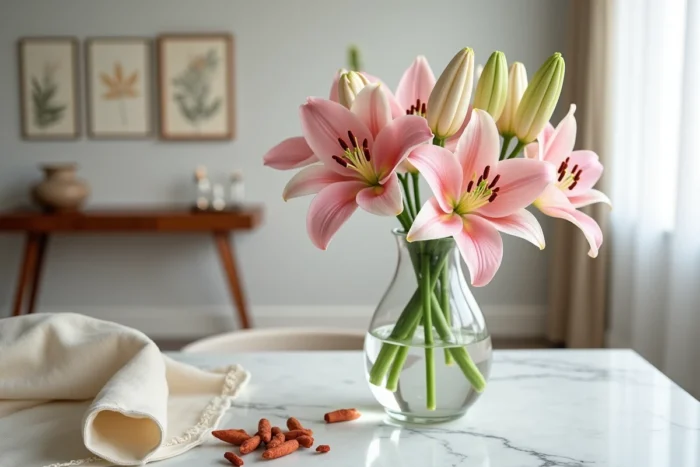
The best time to remove the pistil is just after the bud opens. At this stage, the pollen is not yet powdery and the anthers remain sticky. They detach cleanly without dispersing particles.
Waiting even just twenty-four hours changes the situation. The anthers dry, the pollen becomes volatile, and the slightest movement projects it onto surrounding surfaces.
Visual Sign to Spot
When the petals begin to separate but the anthers retain a dark color and a slightly moist appearance, that’s the signal. If you see a fine orange dust on the petals, you have already missed the optimal window.
Frequency by Varieties
Oriental lilies (like Stargazer) produce abundant and highly pigmented pollen. Asian lilies release less, but their stamens are more exposed due to the flower’s open shape. In both cases, removing the stamens as soon as they open remains the rule.
The Dutch Union of Flower Producers (AIPH) reports that since 2024, breeders have developed varieties of lilies with less abundant and less staining pollen, reducing the need for manual intervention. These hybrids remain minority among general florists.
Technique for Removing Lily Pistils Without Damaging the Flower
The action is simple, but haste causes damage. Here’s the method that floral maintenance professionals use:
- Hold the stem with one hand to stabilize the flower, without pressing on the petals.
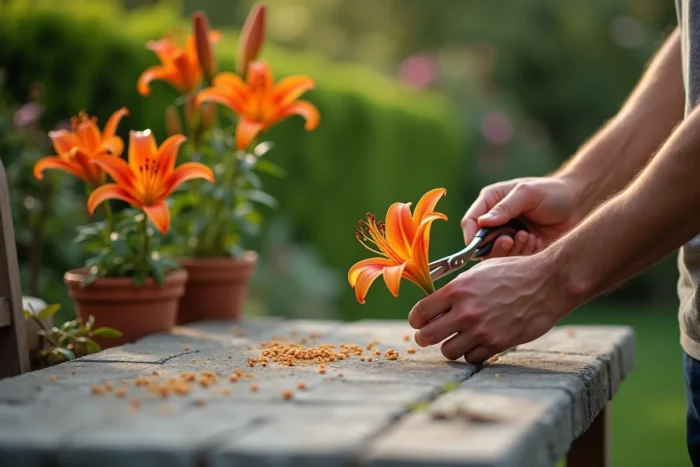
- With the other hand, pinch the base of each anther (the tip of the stamen that carries the pollen) between your thumb and index finger, then gently pull upwards. The anther detaches easily if the flower has just opened.
- Immediately place the anthers in a tissue or bag, never on the table or tablecloth.
- Repeat for each stamen. A lily has six, arranged in a circle around the central pistil.
Some use fine tweezers for more precision, especially on varieties with curved petals that obstruct access. Never cut the stamens with scissors: a clean cut releases trapped pollen in the anther and projects it onto the petals.
A often overlooked point: the central pistil (the female organ, in the middle) does not stain. It is the anther, carried by the stamen (male organ), that contains the pollen. Removing the six anthers is sufficient. Cutting the pistil is unnecessary and detracts from the flower’s appearance.
Lilies in Wedding Decoration: Balancing Elegance and Risk
The lily remains a popular flower for wedding centerpieces and bridal bouquets, thanks to its volume, fragrance, and vase life. However, it is also the flower that generates the most complaints related to pollen stains on dresses and suits.
Suspended arrangements reduce the risk of contact with guests and clothing. This configuration has been gaining traction since 2025 according to feedback from florists specializing in events.
Alternatives to Consider
For brides who want to avoid any handling, dendrobium orchids offer a comparable visual effect without problematic stamens. Garden roses with large buds also fulfill this role.
If you are set on lilies, have the florist remove the stamens on the morning of the event. A pistil-free lily the day before will have already lost some of its freshness, as handling slightly accelerates petal wilting.
Care for Lilies in a Vase After Removing the Stamens
A lily without stamens behaves no differently in a vase, but a few actions can prolong its lifespan:
- Cut the base of the stem at an angle every two days with a clean knife.
- Change the water in the vase daily. Lilies are sensitive to bacteria that develop in stagnant water.
- Keep the vase away from fruits: the ethylene they emit accelerates blooming and thus wilting.
- Maintain a moderate room temperature. Direct heat (radiator, sunlight) shortens the lifespan by several days.
A well-maintained and early pistil-free lily bouquet can easily last a week in a vase. Regular watering and changing the water matter more than any commercial floral preservative.
The remaining lily bulbs after cutting can be replanted in the ground in the fall, in well-drained and slightly acidic soil, to bloom again the following season.