
The dashboard of the Mercedes Vito uses a standardized color code to prioritize its alerts. An orange (or amber) warning light indicates a malfunction that does not require immediate vehicle stoppage but does require a quick check. Unlike a red warning light, which demands immediate engine shutdown, the orange light allows for some action, provided you do not drive hundreds of kilometers while ignoring it.
Orange ESP light on Mercedes Vito: a malfunction or just a sensor
The most frequently reported warning light on forums dedicated to the Vito is the ESP stability control light, represented by a silhouette of a sliding car. Since the regulatory requirement for ESP on all new vehicles sold in the EU (November 2014), every recent Vito is equipped with it.
When this light flashes while driving, it simply indicates that the system is intervening to correct a loss of grip. Nothing unusual. However, when it stays on steadily, the control unit has detected a failure.
The causes behind a steady light are sometimes very trivial. To better understand the meaning of orange lights on a Mercedes Vito, it is important to know that the ESP system shares sensors with the ABS. A slightly dirty ABS sensor, under-inflated or non-compliant tires, or even a weak battery can trigger the alert.
- ABS wheel sensor dirty from mud or brake dust: a cleaning at the workshop often resolves the issue without part replacement.
- Tires of different sizes on the same axle, or insufficient pressure: the control unit interprets the difference in rotation speed as slipping.
- Battery voltage too low after prolonged parking: the ESP system goes into fault mode for safety, and the light disappears after recharging or replacing the battery.
In these cases, the light appears and then disappears after correction, without any major mechanical failure. An electronic diagnosis (reading of ESP/ABS fault codes) allows for a quick distinction between a loose connection and a real failure of the hydraulic block.
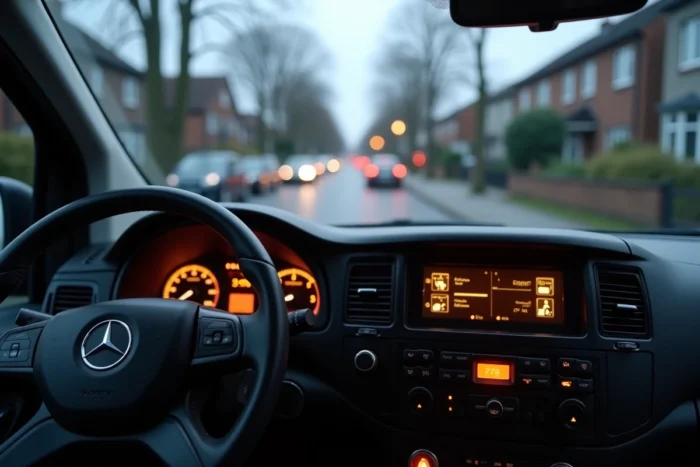
Reduced mode and loss of power: the orange engine light
The engine light (a pictogram in the shape of an engine block) illuminated in orange often triggers a reduced mode with loss of power. The control unit intentionally limits torque to protect the engine or the catalytic converter.
On the diesel Vito, this scenario is frequently related to the pollution control circuit. A dirty EGR valve, a particulate filter undergoing interrupted regeneration, or a faulty differential pressure sensor are the usual suspects.
Differentiating urgency and scheduled maintenance
The reduced mode does not always mean an expensive repair. A highway trip at sustained speed may be enough to restart a blocked particulate filter regeneration caused by exclusively urban driving. If the light persists after this type of driving, a visit to the garage with a diagnostic tool is necessary.
Never erase an engine fault code without identifying the cause. A simple reset may temporarily turn off the light, but the problem will return, often worsened. Electronic diagnosis remains the only reliable way to identify the faulty component.
Frequent confusion: ESP light, EPS, and pre-conditioning on Vito MBUX
Recent diagnostic guides emphasize the confusion between the ESP light and the EPS light (electric power steering). The two pictograms look similar, but the consequences differ radically. An EPS fault affects steering and requires priority intervention, while an ESP fault impacts stability in the event of a loss of grip.
On restyled Vitos equipped with the MBUX system, another source of confusion exists. Some orange lights are not related to a malfunction but to a programmed function like pre-conditioning. The orange icon on the air conditioning control indicates that a departure time is programmed to heat or cool the cabin. Drivers accustomed to older Vitos sometimes interpret this indicator as a mechanical warning.
Identifying the correct pictogram
The most reliable method remains to consult the vehicle’s user manual. On an imported Vito (a common case with used German models), the manual may be in another language. In this situation, photographing the illuminated light and presenting it to a specialized technician or comparing it to online databases of Mercedes codes can help avoid a blind diagnosis.

Reacting to an orange light on the Vito dashboard
The appropriate response depends on the vehicle’s behavior at the time the light comes on. If the driving remains normal (no noise, no vibration, no loss of power), a garage appointment in the following days is usually sufficient.
- Immediately check the coolant level and tire pressure, two common causes for the illumination of orange lights.
- Observe if the vehicle goes into reduced mode: if power is limited, reduce speed and head to a garage without straining the engine.
- Do not disconnect the battery to turn off the light: this action erases stored fault codes and complicates subsequent diagnosis.
- Have the fault codes read by a compatible Mercedes diagnostic tool (OBD2 protocol) to obtain a precise fault number before any intervention.
Since the Vito is a utility vehicle often used as a primary work tool, immobilizing the vehicle without prior diagnosis represents a significant indirect cost. Reading the fault codes before any repair avoids unnecessary part replacements and directly points to the faulty component.
An orange light addressed quickly usually results in a routine maintenance intervention. If ignored over time, it can mask a progressive degradation of the pollution control system, brakes, or power steering, with consequences for the technical inspection and the final bill.