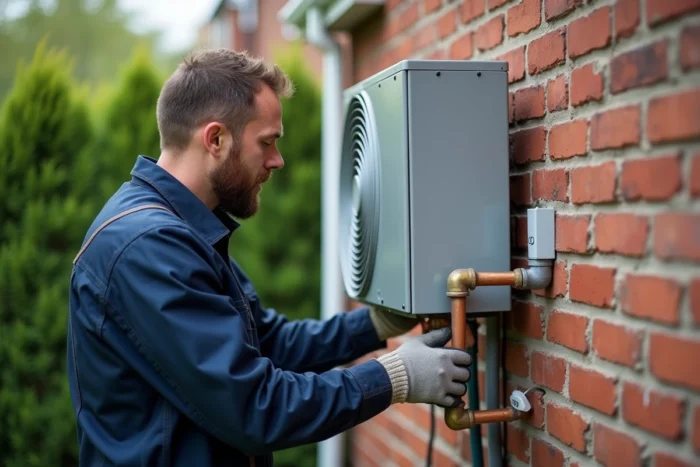
An air-water heat pump captures the calories present in the outside air and transfers them to a water circuit to heat a home. Its installation relies on precise sizing, a hydraulic connection to the existing heating network, and compliance with regulatory constraints that have tightened in recent years.
Refrigerants and regulations: what changes for your air-water heat pump
The choice of an air-water heat pump is no longer limited to comparing power or brands. The regulation (EU) 2024/573 of February 7, 2024 accelerates the transition to refrigerants with a lower global warming potential (GWP). Models operating on R32, common in the market, have a GWP significantly lower than that of the old R410A, but new generations of refrigerants are already emerging.
This evolution has a direct impact on the choice of equipment. A device designed for a low GWP refrigerant will be more easily compliant with future restrictions, which protects the value of the investment over time. When purchasing, checking the type of refrigerant used and its compliance with the F-Gas regulation is a reflex to adopt before signing any quote.
Knowing how to install an air-water heat pump also involves understanding these technical constraints, which condition the choice of equipment as much as the quality of the installation.
Sizing and supply temperature: the technical basics to master
The sizing of an air-water heat pump is based on two fundamental data: the thermal losses of the home and the supply water temperature required for the emission system (radiators or underfloor heating). Underfloor heating operates with water around 35 °C, while high-temperature radiators require water close to 60 °C or even higher.
Current heat pumps are capable of producing high-temperature water, making them compatible with existing radiators during renovations. However, the seasonal efficiency (expressed by the SCOP) decreases as the supply temperature increases. In other words, the hotter the water needs to be, the more electricity the heat pump consumes.
A thermal assessment conducted by a professional allows for determining the necessary power. Undersizing the heat pump forces reliance on costly electric backup. Oversizing generates short cycles that wear out the compressor and degrade comfort. Proper sizing is the factor that separates a high-performing installation from a disappointing one.
Insulation before installation
As highlighted by ADEME, insulating the home before installing a heat pump reduces losses and allows for choosing a lower power device. This logic has a double advantage: reducing the cost of the equipment and improving its seasonal efficiency, as the required supply temperature decreases in parallel.
Location of the outdoor unit: noise, vibrations, and regulatory distances
The outdoor unit of an air-water heat pump emits noise. In densely populated residential areas, this point has become a real concern. The positioning of the unit determines both the perceived noise level by neighbors and the efficiency of the system.
Three criteria guide the choice of location:
- The distance from property boundaries and openings of neighboring homes, framed by regulations on neighborhood noise. A qualified installer knows the thresholds to respect.
- The airflow around the unit. A device placed against a wall in a narrow corner sees its performance drop because the recycled air loses calories. Ensuring sufficient clearance is a condition for proper operation.
- The vibrations transmitted to the building. Placing the unit on anti-vibration pads and on a stable support (concrete slab, metal support) limits the propagation of solid noise to the walls and floor.
Directing the air outlet of the unit towards an open space, away from neighboring bedrooms and terraces, remains the most effective measure to prevent neighborhood conflicts.

Hydraulic connection and commissioning of an air-water heat pump
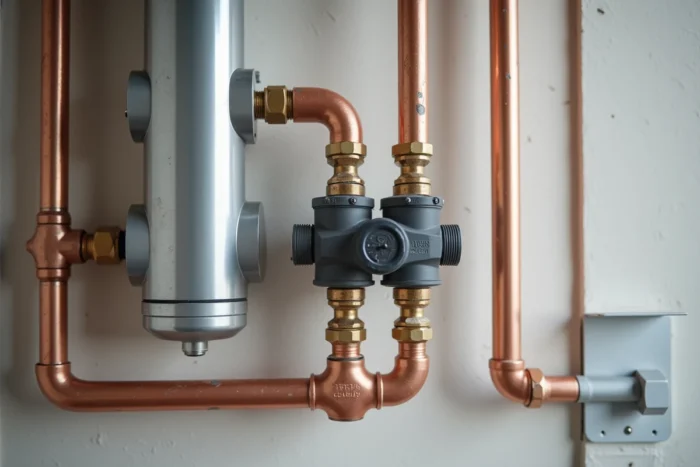
The indoor unit of the heat pump connects to the existing central heating circuit. In renovations, this connection must take into account the type of emitters in place, the volume of the circuit, and compatibility with a domestic hot water tank if the heat pump also provides this function.
The hydraulic circuit requires:
- A buffer volume (buffer tank or decoupling vessel) that regulates the operating cycles of the compressor and avoids too frequent stops/restarts.
- A treatment of the circuit water (de-sludging, addition of corrosion inhibitor) to protect the heat exchanger of the heat pump, which is particularly sensitive to deposits.
- A setting of the heating curves adapted to the outside temperature, so that the heat pump modulates its power instead of operating in an all-or-nothing manner.
The commissioning must be carried out by a certified RGE installer for the installation to be eligible for financial assistance. This certification attests to verified competence in handling refrigerants and system configuration.
Financial assistance and installation requirements
Programs like MaPrimeRénov’ and energy savings certificates (CEE) condition their payment on compliance with enhanced technical requirements. The minimum seasonal efficiency of the device and the quality of the installation are among the verified criteria. A quote signed before the validation of the assistance file may lead to the loss of funding: the administrative timeline is as important as the technical quality.
Mandatory maintenance, to be carried out at least every two years by a qualified professional, also conditions the maintenance of manufacturer warranties. Planning a maintenance contract from the commissioning stage avoids unpleasant surprises regarding the lifespan of the equipment.