
A construction project is not determined at the moment the first stone is laid. It is won or lost during the technical decisions of the first six months: structural choices, regulatory compliance, anticipation of networks. Design errors cost ten times more to correct during the construction phase than in the study phase.
Photovoltaic pre-equipment and technical reservations from the design stage
We systematically recommend designing the roof as a future support for solar production, even without immediate installation. Orientation of slopes, sizing of rafters to support the extra weight of the panels, routing of electrical conduits to the distribution board: these reservations represent a marginal additional cost during the structural phase.
Ignoring this step forces a rework of the framework or drilling through technical floors during a later installation. The RE2020 already encourages on-site renewable energy production, and a roof “ready for photovoltaics” avoids costly structural reinforcements.
Pre-equipment also concerns the electric vehicle charging station. Running a suitably sized cable between the main panel and the garage during the finishing phase amounts to just a few meters of conduit. Doing it afterward means opening finished partitions. We observe that most builders offering this service as an option charge well beyond the actual cost of wiring if it had been planned from the start.
For everything about Habitat Guides, the technical sheets detail the reservation items not to forget before pouring the slab.
RE2020 and carbon impact: what it changes in your house plan

The RE2020, in effect since 2022, is not limited to strengthening thermal insulation. It introduces a greenhouse gas emissions ceiling over the building’s life cycle. In practice, this pushes towards low carbon footprint materials: wood frame, bio-based insulation, low carbon concrete.
This paradigm shift directly modifies the design of rooms. Wood frame walls, thicker for equal thermal performance than a traditional concrete wall, reduce the net usable area if the footprint remains the same. We recommend recalculating usable areas room by room from the preliminary project stage to avoid disappointments at delivery.
Feedback from project managers converges on another point: reducing glazed areas facing north and adding fixed solar protections to the south to limit summer overheating in living spaces. A largely glazed south-facing living room without a facade overhang or adjustable sunshade turns the room into a sauna from June to September, degrading comfort and the energy performance rating (DPE).
- Plan for roof overhangs or concrete canopies to the south, sized according to the site’s latitude, to block summer sun without penalizing winter solar gains.
- Limit the glazing/wall ratio on the north facade to what is required for natural lighting, without excess, to contain heat losses.
- Integrate a dual-flow ventilation system from the design stage, with reserved ducts in the false ceilings, rather than a single-flow mechanical ventilation system added later.
Zero Net Artificialization: constraints on land and construction plan
The Climate and Resilience Law sets a Zero Net Artificialization target by 2050, with an initial step of halving the consumption of natural, agricultural, and forest spaces by 2031. For an individual, the direct consequence is the scarcity of buildable land and the mechanical increase in their price in tight areas.
Building on a smaller plot requires rethinking the interior layout. “L” or “U” shaped plans that waste ground footprint give way to compact volumes over two levels, with living spaces on the ground floor and bedrooms upstairs. This format also reduces the length of foundations and roof area, which keeps the structural budget in check.
The soil of the plot deserves special attention. Some municipalities now require a G2 type geotechnical study before issuing a building permit, especially on clay soils subject to shrink-swell. Neglecting this study exposes one to structural cracking a few years after delivery.
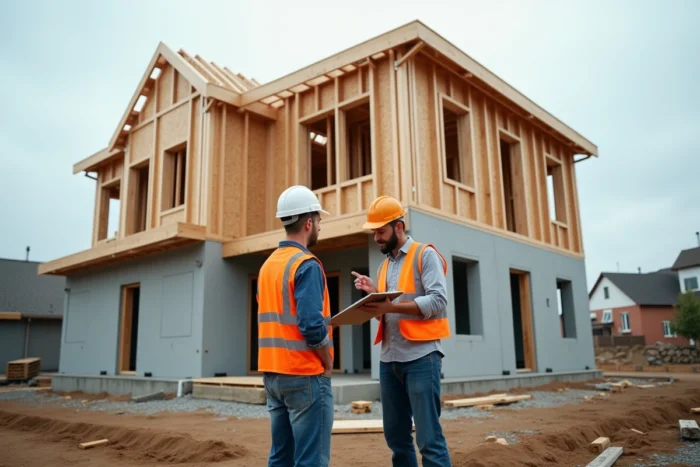
Interior layout: technical decisions often underestimated
The circulation between rooms consumes a significant part of the usable area. A classic distribution corridor can represent a notable fraction of the total surface. We favor linear distributions or through rooms that eliminate corridors without sacrificing the privacy of bedrooms.
The choice of flooring affects the height of the reservation in the slab. Large format tiles laid on a fluid screed do not have the same thickness as engineered wood flooring on acoustic underlay. If both coexist in the house, the finished level of each room must be calculated from the execution plan to avoid unsightly thresholds or the need for leveling corrections.
- Define the type of flooring by room before pouring the screed, not afterward.
- Plan for electrical provisions for roller shutter motors, even if the initial budget only covers manual shutters.
- Position network sockets (RJ45) in each main room: Wi-Fi alone is not sufficient for stable teleworking.
- Reserve a technical location for a thermodynamic balloon or an air/water heat pump, with associated condensate drains.
The layout of the outdoor space, including terrace and garden, benefits from being thought out at the same time as the house. The level of the terrace in relation to the threshold of the bay window, the direction of rainwater drainage, the routing of buried irrigation networks: all these elements, if addressed afterward, generate additional earthworks on an already developed plot.
A successful construction project relies less on the choice of a decorative style than on the rigor of preliminary studies and the quality of technical reservations. The decisions made on paper, before the first shovel hit the ground, determine the comfort, energy performance, and resale value of the house for the following decades.