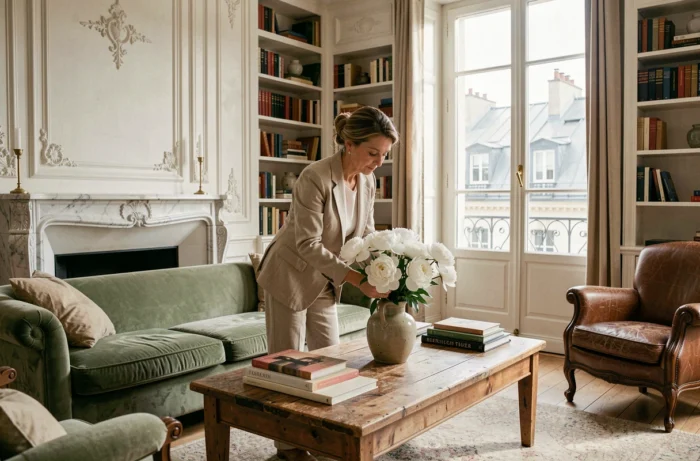
A herringbone parquet that creaks underfoot, light filtered through sheer curtains, a vintage armchair placed near a marble fireplace: the Parisian art of living lies in these details. Decorating an apartment in Paris is not just about stacking moldings and antique furniture.
It’s a balance between the character of the existing structure and the very concrete constraints of city life, starting with energy performance and co-ownership rules.
Energy constraints and decoration in Paris: the DPE changes the game
Have you ever noticed that some Parisian apartments have incredible charm but a disastrous energy performance diagnosis (DPE)? This is not a cosmetic detail. The DPE now conditions the right to rent a property, and this reality directly impacts decoration and layout choices.
Renovation work in an old apartment must integrate insulation, ventilation, heating, and carpentry, well beyond mere aesthetic considerations. In practical terms, applying a lime plaster to a stone wall for its character without addressing the thermal bridge behind it is like decorating a sieve.
Classic decor guides talk about moldings, parquet, and furniture. They overlook the fact that in Parisian co-ownership, changing a window or insulating an exterior wall requires a vote at the general assembly. Initiatives like CoachCopro assist buildings in these collective renovations, but the decision does not rest solely with the owner of an apartment.
To delve deeper into the specifics of Parisian housing, the home page of Faits sur Paris gathers content that intersects housing, regulations, and daily life in the capital.

Protected heritage and interior renovation in Paris
Paris has a considerable number of protected sectors. In these areas, particularly around many historic buildings in the 8th arrondissement, replacing windows, external insulation, and façade modifications may require specific heritage approvals.
Why is this point crucial for decoration? Because it limits options. It is impossible to install contemporary double glazing if the Architect of the Buildings of France requires the retention of small wooden window frames. The interior aesthetics must then work within these façade constraints.
Adapting style without touching the envelope
When the façade is untouchable, the layout focuses on three levers:
- Thick curtains and drapes, which improve acoustic and thermal insulation without altering the external carpentry, while adding texture to the decor.
- Interior wall coverings (thin insulating plasters, technical wallpapers) that add a layer of comfort without encroaching on the living space.
- Partition furniture (open bookshelves, wooden screens) that redefines the space without structural intervention, an asset in the typical enfilade rooms of Haussmannian architecture.
Decorating a protected Parisian apartment means working within strict interior constraints. This limitation drives creative solutions that new housing does not require.
Parisian kitchens and living rooms: furniture that meets small space needs
The average size of Parisian apartments is significantly smaller than that of homes in the provinces. This lack of space imposes concrete trade-offs on furniture and layout.
The kitchen as a living space
In many old apartments, the kitchen was a closed room, sometimes tiny. The current trend is to open it up to the living room to gain brightness and perceived space. A well-thought-out open kitchen visually enlarges an apartment by several square meters.
The choice of countertop, high storage, and built-in appliances is as much about design as it is about optimization. A central island, even narrow, can serve as a preparation area, dining spot, and visual separation from the living room.
The multifunctional living room
The Parisian living room serves multiple roles: reception, office, sometimes a spare bedroom. Transformable furniture (sofa bed, extendable table, foldable desk) is not an aesthetic compromise; it is a marker of the Parisian lifestyle.
Favoring dual-purpose furniture pieces allows for an airy interior without sacrificing comfort. A designer armchair paired with a coffee table that doubles as storage: this is a typically Parisian choice, where beauty and utility coexist out of necessity.
Parisian art of living: mixing eras without falling into pastiche
The Parisian decorative identity is based on a simple principle: no piece of furniture should give the impression of having been purchased on the same day in the same place. An apartment that breathes the Parisian art of living combines an antique dresser, a contemporary light fixture, and an object brought back from a trip.
This mix works when it adheres to a coherent palette. Two or three dominant shades are enough to unify pieces of furniture from very different eras. The off-white of the walls, the dark wood of an old parquet floor, and an accent color on a chair or wall create a readable thread.
The role of natural materials
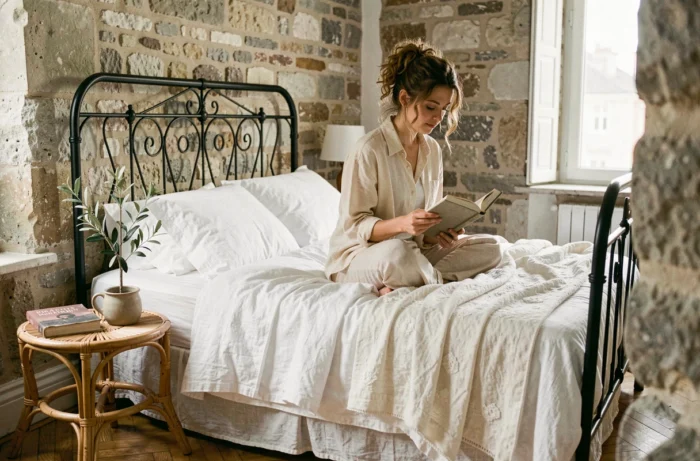
Linen, rattan, stone, and brass appear in most well-thought-out Parisian interiors. These materials age without going out of style, aligning with a decorative approach where one accumulates over the years rather than changing everything each season.
Why this choice over less expensive synthetic materials? Because in an old apartment, the patina of a natural material dialogues with that of the structure. An old tile floor does not pair well with a white melamine piece; however, it naturally harmonizes with solid wood or aged metal.
Decorating an apartment in Paris is not limited to reproducing a style seen in a magazine. It is a constant exercise in adaptation between the constraints of the structure, regulatory obligations, and personal desires. The true Parisian art of living consists of making these constraints invisible, so that only the pleasure of living remains visible.